Thornback Ray
Raja clavata
Print fact sheet (PDF)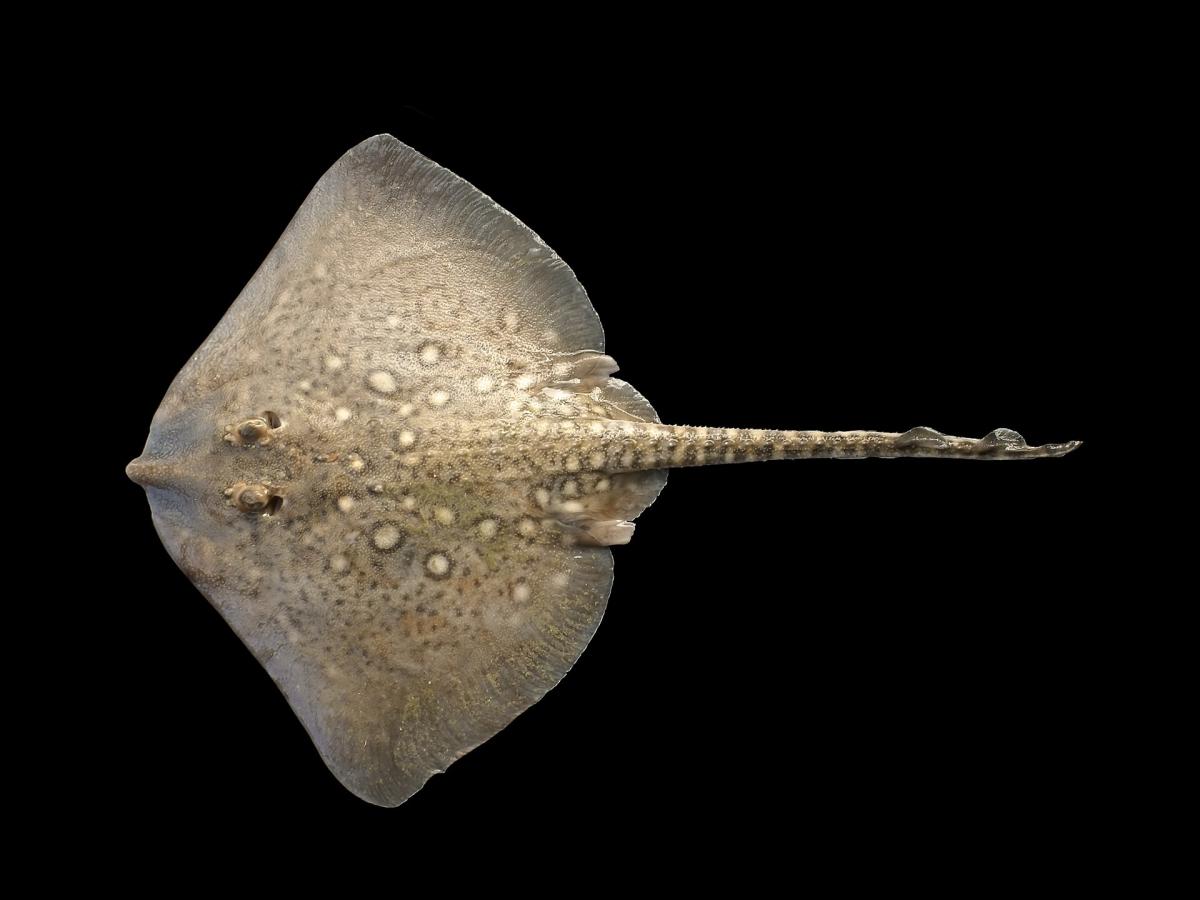
Covered in curved thorns along the back and tail — and it hunts by detecting electric fields.
A flat, diamond-shaped ray, mottled brown and grey above with a pale underside, and studded with strong curved thorns along the back and tail — the feature that names it and separates it from other local rays. Thornbacks live over sand, mud and gravel in the Solway and the Irish Sea, often in fairly shallow water.
Behaviour
Thornback rays lie half-buried and hunt crabs, shrimps and flatfish, detecting buried prey through electroreceptors — jelly-filled pores in the snout that pick up the faint electrical fields of living animals. Females lay tough oblong eggcases with a stiff horn at each corner, and these too wash up as mermaid's purses. They are slow-growing and late-maturing, which makes the species sensitive to fishing pressure.
When to see it
Quick facts
- Family
- Skates and rays (Rajidae)
- Size
- Commonly 60–90 cm across
Photo by Hans Hillewaert, CC BY-SA 4.0, via Wikimedia Commons