Osprey
Pandion haliaetus
Print fact sheet (PDF)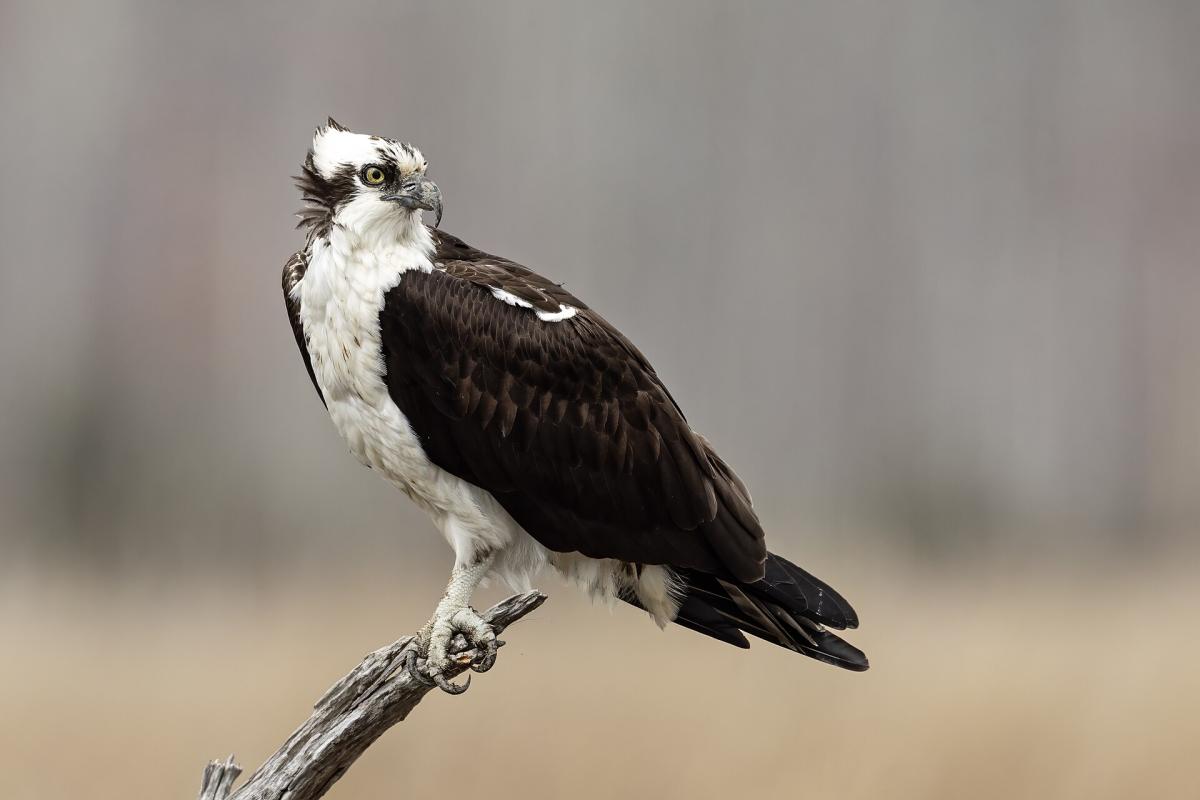
A fish-eating hawk that hits the water feet-first and comes up carrying dinner head-forwards.
A large, long-winged raptor, dark brown above and startlingly white below, with a white head crossed by a dark band through the eye. Ospreys returned to Scotland in the 1950s after being driven to extinction, and now breed at scattered sites across the country including Dumfries and Galloway. They need large fish-holding water — loch, reservoir or estuary — within reach of a tall nest tree.
Behaviour
The hunting dive is spectacular: the bird hovers, then plunges feet-first, often submerging completely, and hauls out with a fish gripped in both feet. Barbed pads on the soles and a reversible outer toe give the grip; the fish is then turned head-forwards to cut drag in flight. Nests are huge stick platforms at the top of a pine, added to year after year by a returning pair.
Migration
Scottish ospreys winter in West Africa, mainly Senegal, The Gambia and Guinea-Bissau. Satellite tracking has shown individual birds returning to the same nest tree — and the same African roost — for a decade or more, a round trip of some 5,000 miles each way.
When to see it
Quick facts
- Family
- Ospreys (Pandionidae)
- Size
- 52–60 cm · wingspan up to 1.7 m
- UK status
- Amber-listed
Photo by Chuck Homler / Focus On Wildlife, CC BY-SA 4.0, via Wikimedia Commons